

Brands often ask what a leather bag costs to make, hoping for a number. The honest answer is that the same sketch can cost wildly different amounts depending on decisions that have not been made yet — and that understanding the structure of the cost is far more useful than any single figure.
This article breaks down where the money actually goes, and which choices move the number most.
The five components of a unit cost
Every leather goods quote resolves into five parts.
Leather. Usually the largest single line, and the least predictable. Cost is driven not by the price per square foot but by how many square feet the pattern consumes after yield losses.
Other materials. Lining, interlining, reinforcements, thread, adhesive, zips, and hardware. Hardware in particular ranges enormously — a custom-plated, branded closure can cost more than the leather in a small item.
Labour. Measured in minutes of skilled work across cutting, skiving, edge preparation, stitching, assembly and finishing.
Overhead and margin. The factory's fixed costs and profit, usually applied as a percentage.
Amortised setup. Tooling, cutting dies, embossing plates and pattern development, spread across the order quantity.
Leather: consumption, not price per foot
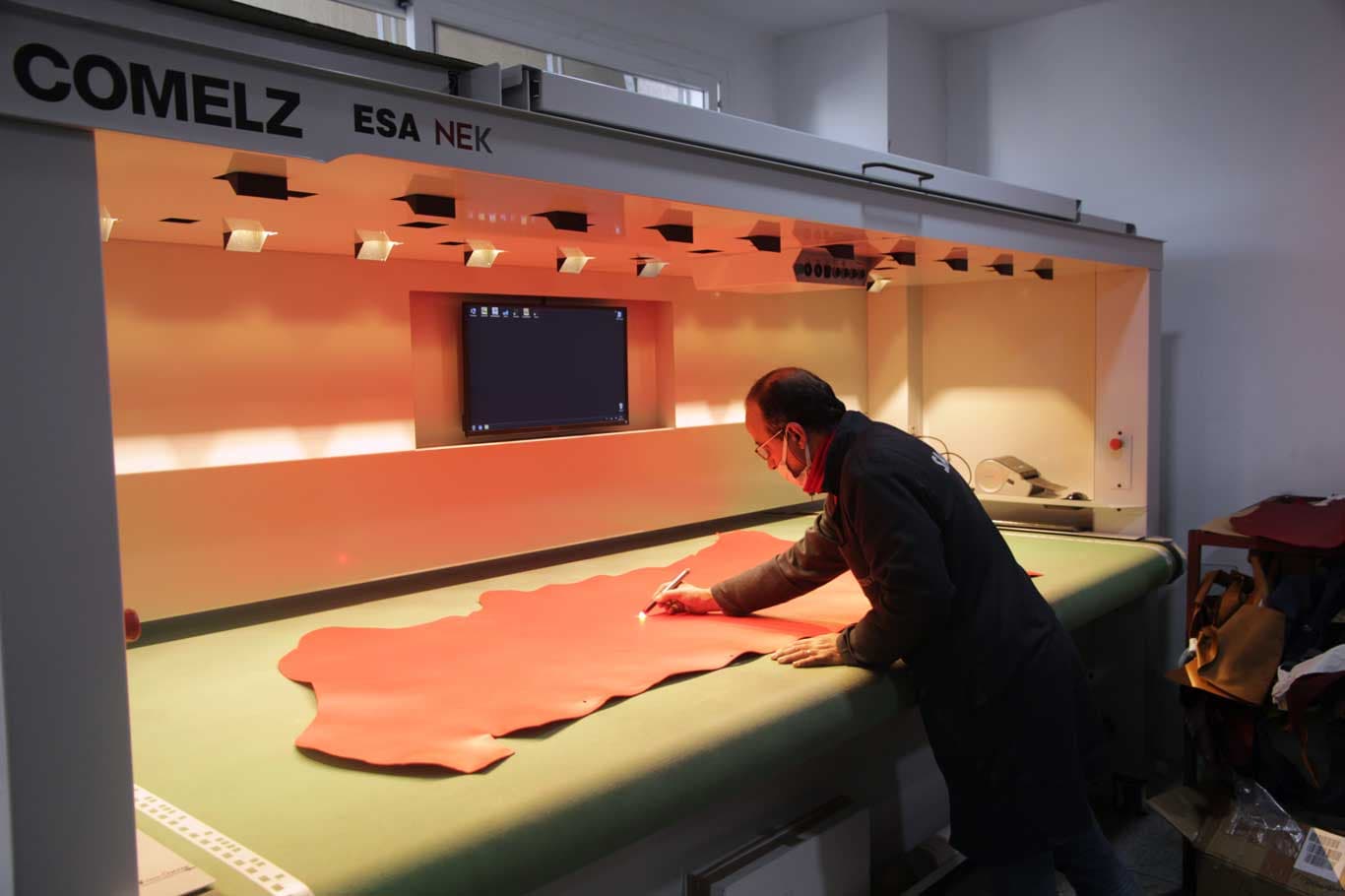
This is the part brands consistently underestimate. A hide is an irregular shape with natural defects, variable thickness and directional stretch. Pattern pieces must avoid the defects, respect the stretch direction, and fit within the usable area.
The result is that a bag needing, say, twelve square feet of finished panels may consume considerably more raw hide. That gap — the yield loss — is a real cost that appears in your unit price whether or not anyone explains it.
Several factors drive it:
- Panel size. Large single panels are harder to place around defects than small ones and produce more waste.
- Leather grade. Higher grades have fewer defects and better yield, partly offsetting a higher price per foot.
- Directionality. Patterns that must run in a fixed direction constrain nesting and reduce yield.
- Nesting quality. Modern CNC cutting with software nesting recovers meaningfully more usable area than manual placement.

A practical consequence: asking a factory to quote a slightly smaller bag, or to allow a seam where a single large panel was specified, can reduce leather cost more than negotiating on price per foot ever will.
Hardware and components
Hardware costs are driven by three decisions.
Stock or custom. Off-the-shelf hardware is dramatically cheaper and has no tooling cost. Custom hardware requires moulds or dies, carries a minimum order quantity of its own, and adds weeks to the development calendar.
Plating and finish. Standard finishes are inexpensive. Specialised platings, and finishes that must survive corrosion or abrasion testing, cost more and sometimes fail testing on the first attempt.
Quantity. Hardware minimums frequently exceed bag minimums, which means a small first order may have to absorb the cost of a larger hardware purchase.
Our guide to hardware selection covers the specification side in more detail.
Labour: count the minutes
Labour cost is a function of construction complexity, not size. A large, simply constructed tote can take fewer minutes than a small, heavily finished wallet.
The operations that consume the most time are usually edge finishing, particularly painted edges requiring multiple coats with drying and sanding between them; skiving and folding, where every folded edge is a separate operation; lining construction, where a fully lined and pocketed interior can double assembly time; and hand operations of any kind.

Construction decisions therefore dominate labour cost. Choosing a raw or burnished edge rather than a multi-coat painted edge, or reducing the number of interior compartments, changes the minute count immediately.
Tooling and sampling
These are one-time costs, but they are real and they are often omitted from early estimates.
Cutting dies are made per pattern piece. A bag with many distinct pieces needs many dies.
Embossing and foil plates are made per logo, per size.
Pattern development is skilled work, especially where a sketch must be turned into a production-ready pattern.
Sample rounds each carry cost. First samples are rarely right, and two to three rounds is normal. Budgeting for one is the most common planning error we see.
Because these are amortised across the order, they weigh heavily on small first orders and become negligible at volume. This is a large part of why minimum order quantities exist at all.
Why two quotes for the same sketch differ
When brands receive quotes that differ substantially, the cause is almost always one of these, not a difference in efficiency:
- Different leather grade assumed, where the sketch did not specify one
- Different hardware assumed — stock versus custom
- Different construction assumed — lined versus unlined, painted versus raw edges
- Different Incoterm, so one price includes freight and duty and the other does not
- Different quantity used to amortise tooling
- Sampling and tooling included in one quote and excluded from the other
The fix is a complete specification. A tech pack that fixes leather, hardware, lining and construction makes quotes genuinely comparable, and is the single highest-return document a brand can prepare.
What to do with this
If your target cost is fixed, share it early. A competent manufacturer can tell you which specification choices will reach it and which will not — usually within one conversation, and long before anyone has spent money on samples.
If you want that conversation for a specific product, send us the details and we will walk through where your cost is actually going.