

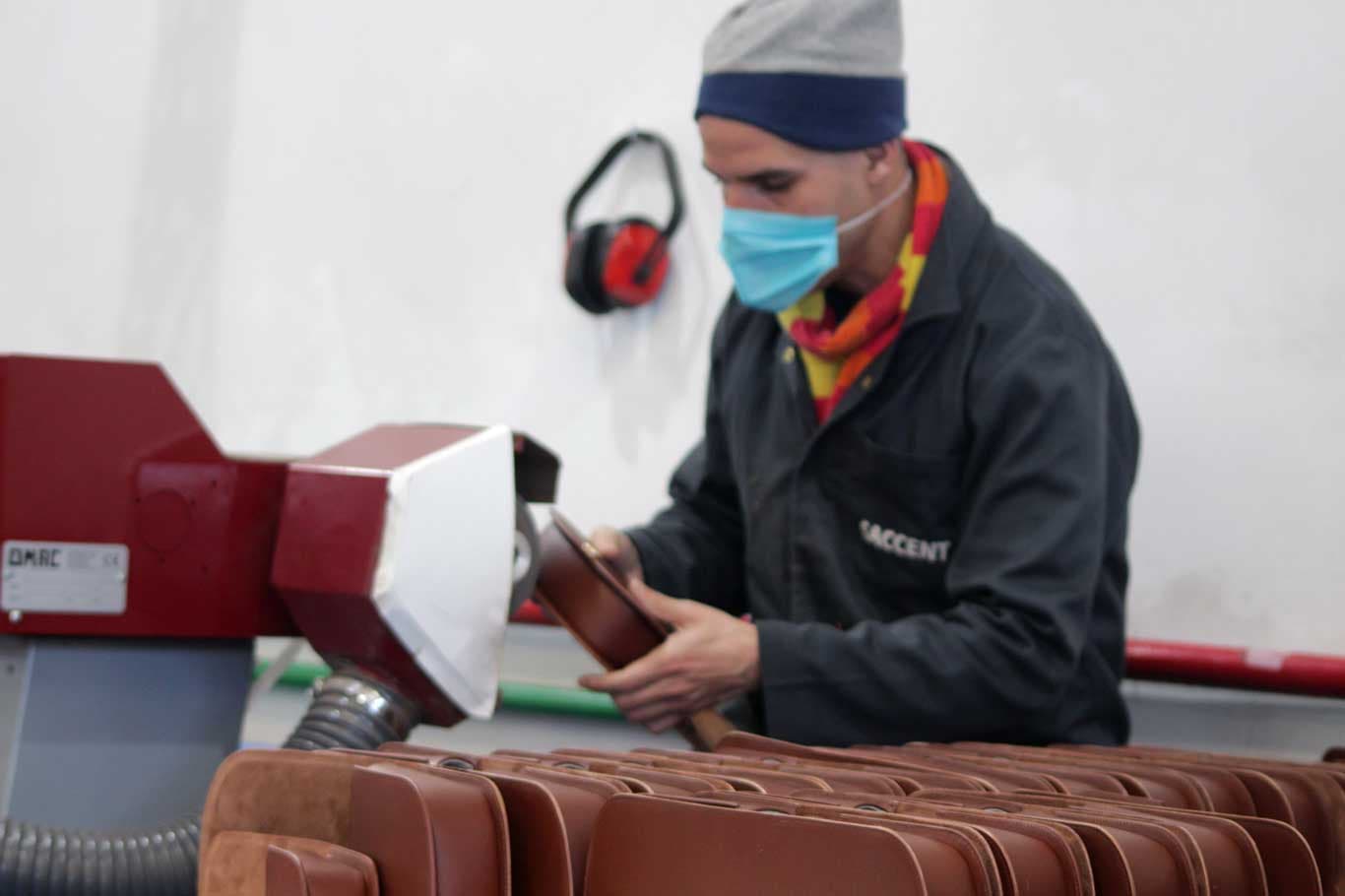
Edges are where leather goods are judged. A well-made bag with a poor edge looks unfinished; a simple bag with a beautifully resolved edge reads as expensive. Edge treatment is also one of the largest single drivers of labour cost, which makes it a decision worth understanding rather than delegating.
This guide covers the four main approaches and where each belongs.
Why edges matter
A cut edge exposes the interior structure of the leather — the corium, loose fibres, and any layers bonded together. Left untreated on most leathers this looks raw and, more practically, absorbs moisture and abrades over time.
Edge finishing closes that surface. It is protective as much as cosmetic.
Painted edges
The most common finish on structured luxury goods. The edge is prepared, then built up with successive coats of edge paint, with sanding and drying between coats.
The process typically runs: trim and level the edge, sand smooth, apply a base coat, dry, sand, apply further coats, dry, sand, then a final coat and often a heat or friction treatment to smooth and seal it.
Each coat needs drying time that cannot be compressed. This is why painted edges dominate labour cost — the number of coats is effectively a multiplier on the whole finishing stage.
Coat count is what separates quality tiers. A basic edge might have two coats. A luxury edge can have many more, each sanded, producing a rounded, glass-smooth surface with no visible layer transitions.
Fails by: cracking where the edge flexes, chipping at corners, or separating from the leather if preparation was poor. A painted edge on a panel that bends repeatedly is a design problem, not a finishing problem.
Specify: colour, number of coats, finish level — matte, satin or gloss — and profile, whether flat or rounded.

Folded edges
The leather is skived thin at the margin, folded back on itself, and glued or stitched down. No raw edge is visible at all.
Looks like: a soft, rounded, fully closed edge. Traditional in fine leather goods and small leather goods particularly.
The process requires accurate skiving — the leather must be thinned precisely so the fold lies flat without bulk. Corners are the difficult part, requiring the skill to fold cleanly without creating a lump.
Advantages: extremely durable, since there is no applied coating to crack or chip. Soft to the touch. Ages well.
Costs: high labour, and it consumes more leather since the folded margin is additional material. It also requires leather thin enough or skivable enough to fold, which rules out heavier weights.

Specify: fold width, whether the fold is glued only or glued and stitched, and corner treatment.
Burnished edges
The edge is sanded, dampened, treated with a compound such as gum tragacanth or wax, then rubbed at speed until friction and heat compress and polish the fibres into a smooth, sealed surface.
Works on: vegetable-tanned leather primarily. Veg-tan has the fibre structure and density to burnish to a glassy finish.
Does not work on: most chrome-tanned and heavily finished leathers, which will not compress in the same way. Attempting to burnish them produces a disappointing, fuzzy result.
Looks like: a natural, slightly darker edge with a subtle sheen. Understated, and prized in traditional leatherwork.
Advantages: no applied coating means nothing to chip or peel. Ages beautifully, and can be refreshed.
Specify: the compound, the degree of polish, and whether the edge is dyed before burnishing.
Raw edges
The edge is cut cleanly and left untreated, sometimes trimmed or lightly sanded.
Works on: firm, dense leathers where a clean cut looks intentional. Also common in deliberately casual or utilitarian designs.
Advantages: no labour cost, no coating to fail.
Risks: on soft or loosely structured leather a raw edge looks unfinished and will fuzz with wear. On bonded or split materials it exposes the layers. A raw edge is a legitimate design choice on the right leather and a defect on the wrong one.
Comparison
Method | Labour | Leather use | Durability | Best leathers |
|---|---|---|---|---|
Painted | High | Standard | Good, can chip | Most, especially firm |
Folded | High | Higher | Excellent | Thin or skivable |
Burnished | Moderate | Standard | Excellent | Vegetable-tanned |
Raw | Minimal | Standard | Varies | Firm, dense only |
Matching method to product
Structured handbags usually take painted edges, which suit firm panels and give a crisp line.
Small leather goods — wallets, card holders — often use folded edges, since the leather is thin and the tactile quality matters at close range.
Belts and straps frequently burnish well, particularly in vegetable-tanned leather.
Casual and utility products may use raw edges deliberately.
The wrong pairing is visible immediately: a painted edge on a very soft leather cracks where the panel flexes, and a folded edge attempted on leather too thick to skive produces bulk at every corner.
Specifying edges properly
Vagueness here produces disappointment. In the tech pack, state the method, the colour with a reference, the number of coats for painted edges, the profile, the finish level, and the corner treatment.
Then approve a physical edge sample. Edge colour in particular is difficult to judge from a screen, and the difference between a satin and gloss finish is far more visible in the hand than in a photograph.
What good looks like
On inspection, a well-executed edge is consistent in width along its whole length, free of visible layer transitions or sanding marks, smooth to the touch with no roughness, cleanly resolved at corners, and even in colour with no thin patches where the substrate shows.
Corners are the tell. Straight runs are relatively easy; a clean corner requires skill.
Where to go from here
Edge treatment sits at the intersection of appearance, durability and cost. Deciding it early — during development rather than after sampling — avoids reworking patterns and rebuilding cost.
Our guide to stitching and construction covers the adjacent decisions. If you want to see edge samples in different methods and finishes, ask us.