

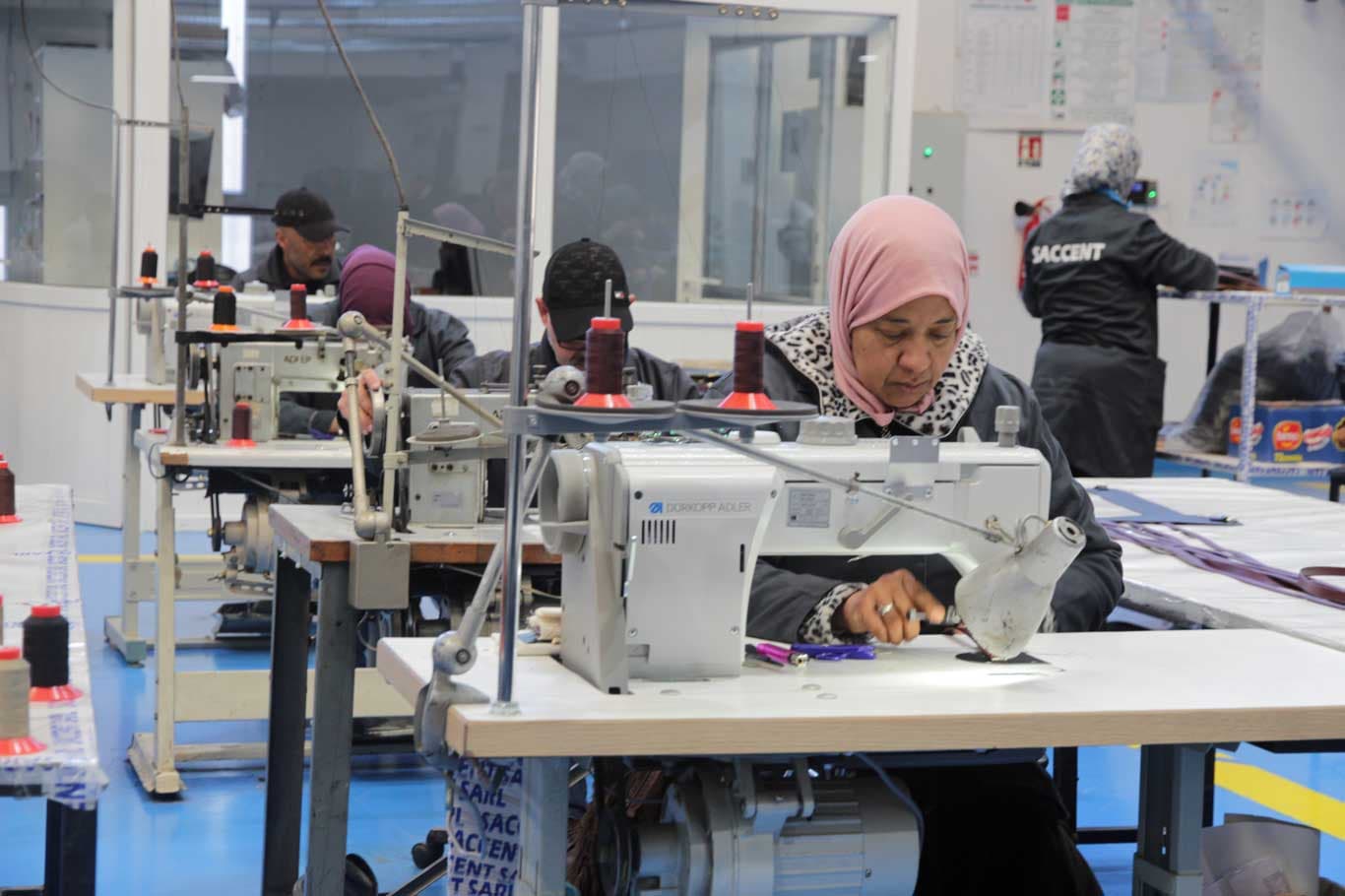
Stitching does two things at once. It holds a product together, and it is one of the most visible signals of how well that product was made. Specifying it properly means understanding both roles.
This guide covers stitch types, density, thread, and the construction methods that determine how a bag is assembled.
Saddle stitch versus machine lockstitch
Saddle stitching is done by hand with two needles on a single thread, each passing through the same hole from opposite sides. The threads cross within the hole.
Its defining property is failure behaviour. If one section of thread breaks, the stitch does not unravel, because each stitch is independently locked by the crossing threads. A saddle-stitched seam degrades locally rather than opening up.
It is slow. A hand-stitched seam takes many times longer than a machine seam, which is why it appears on high-value items, short runs and areas of visible craft emphasis rather than throughout a production bag.
Machine lockstitch uses two threads — an upper thread and a bobbin thread — locking between the layers. It is fast, extremely consistent, and the standard for production leather goods.
Its failure mode is different: a broken thread can allow a run of stitches to loosen. In practice, with correct thread and tension, this is rarely a problem in normal use.
The honest comparison: hand saddle stitching is more robust per stitch and carries genuine craft value. Machine stitching is more consistent, and consistency is itself a quality attribute. A well-executed machine seam looks better than a poorly executed hand seam, and most luxury leather goods on the market are machine-stitched.

Machine types
Different seams need different machines, and the range available in a factory tells you what it can build.
Flatbed machines handle flat panels — the fastest and most straightforward.
Post-bed machines have a raised column allowing work to be manipulated around it, essential for attaching gussets and stitching three-dimensional assemblies.
Cylinder-arm machines have a narrow horizontal arm, letting tubular or closed shapes pass around it. Necessary for finishing bag bodies once closed.
A factory with only flatbed machines is limited to relatively simple construction, whatever it says.

Stitch density
Stitch density is measured in stitches per inch (SPI) or as stitch length in millimetres. Lower SPI means longer stitches.
Density is a real engineering decision, not only an aesthetic one.
Higher density distributes load across more points and looks finer and more precise. But every stitch is a perforation, and perforations weaken leather. Beyond a certain density the line of holes becomes a tear line — the same principle as a postage stamp.
Lower density leaves the leather stronger between stitches and reads as more robust and utilitarian, but distributes stress across fewer points.
Typical ranges run from around 4 to 6 SPI on heavy leather goods and straps, up to 8 to 12 SPI or finer on small leather goods and fine work. The right figure depends on leather thickness and thread size — fine stitching on thick leather looks wrong, and coarse stitching on a thin wallet looks cruder still.
Specify SPI explicitly. It is one of the most visible quality signals and one of the most commonly omitted specifications.
Thread
Polyester is the production standard: strong, UV-stable, abrasion resistant, colourfast, and available in a wide range of thicknesses and colours.
Bonded nylon is very strong with good abrasion resistance, though less UV-stable than polyester over long exposure.
Linen, usually waxed, is traditional for hand saddle stitching and has a distinctive matte appearance. Less strong than synthetics and more affected by moisture.
Thread thickness must suit both the leather and the stitch density. Thread too heavy for the leather looks clumsy and requires large needles that perforate excessively; thread too fine looks weak and wears through.
Colour is a design decision with real consequences. Tonal thread makes the seam recede. Contrast thread makes the stitching a feature — and makes every irregularity visible, which raises the execution standard required.
Needles
Leather needles have cutting points rather than round points, and the point geometry determines how the hole is cut and therefore how the stitch line looks and behaves.
Different point shapes produce stitches that lie straight or at an angle. This is a subtle detail that materially affects appearance, and it is worth confirming that a factory is using leather points rather than textile needles — a real difference in the finished result.
Construction methods
Turned construction. Panels are stitched face to face and then turned right side out, hiding the seam allowance inside. Produces a clean exterior with no visible raw edges. Requires leather supple enough to turn without permanent creasing, and bulk at corners is the main challenge.
Raw-edge or butted construction. Panels are stitched with the edge exposed, then the edge is finished — painted, folded or burnished. Standard for structured bags, and the reason edge finishing matters so much.
Structured construction. Reinforcements, stiffeners or moulded components are built into the panels so the bag holds its shape when empty. Adds materials, operations and cost, and is what separates a bag that stands up from one that slumps.
Lined versus unlined. A lining hides internal construction, protects contents and allows pockets, but adds significant assembly time. Unlined construction exposes the reverse of the leather and demands a leather whose flesh side is presentable.

Adhesive
Rarely specified by brands, and important. Most leather goods are glued before stitching — adhesive holds components in exact position so the stitch line is accurate, and contributes real strength to the assembly.
Poor adhesive work shows up as panels shifting during stitching, visible glue seepage at edges, or delamination in use.
What to specify
- Stitch density in SPI or stitch length
- Thread type, thickness and colour, with a reference
- Which seams are machine-stitched and which, if any, are hand-stitched
- Construction method — turned, raw-edge, structured
- Lining specification
- Reinforcement at stress points such as strap anchors and handle attachments
- Backstitch or lock-off treatment at seam ends
What good looks like
Straight, even stitch lines with consistent distance from the edge. Uniform stitch length along the whole seam. Even tension, with no puckering and no loose loops. Clean, secured seam ends. Matching density across comparable seams on the same product.
The places to inspect are the ones under stress: strap attachments, handle anchors, gusset joins and corners. These are where construction quality is genuinely tested.
Where to go from here
Stitching and construction decisions interact with leather choice, thickness and edge treatment. They are best resolved together during development rather than in sequence.
Our guide to leather thickness and temper covers the material side. If you want to see stitch density and thread options on your intended leather, ask us for samples.