

Most leather specifications stop at type and colour — "black full-grain calf" — and then everyone is surprised when the sample feels wrong. Type and colour describe perhaps half of what determines how a leather behaves in a finished product.
This guide covers the parameters that make up a complete specification.
Thickness
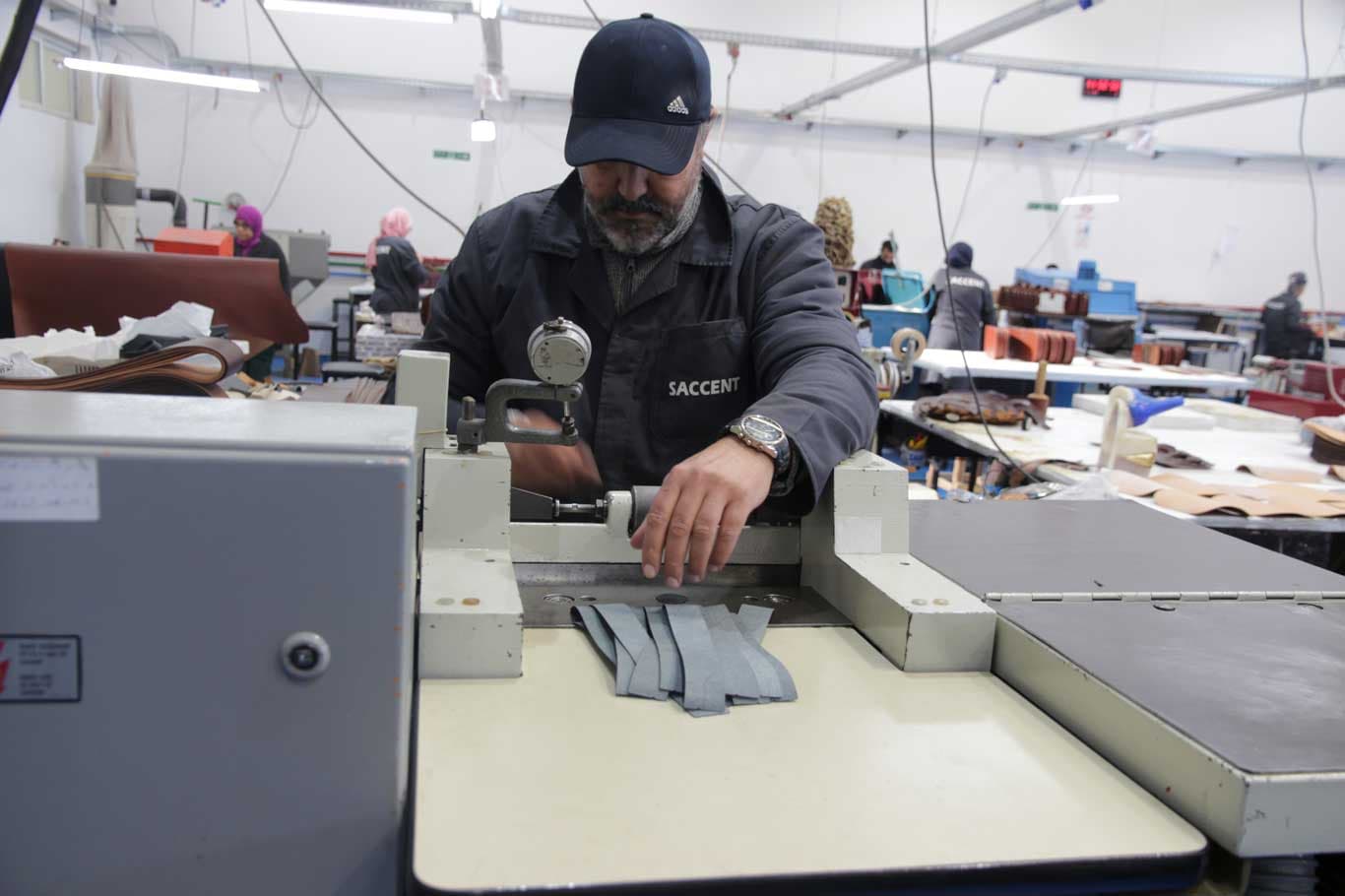
Thickness is measured in millimetres, or in ounces in some markets, where one ounce corresponds to approximately 0.4 mm. A hide is split and shaved to a target thickness, usually expressed as a range rather than a single figure because natural variation across a hide cannot be eliminated entirely.
Rough guidance by application:
Application | Typical range |
|---|---|
Linings, folded edges | 0.4–0.8 mm |
Small leather goods | 0.8–1.2 mm |
Bag panels, soft | 1.0–1.4 mm |
Bag panels, structured | 1.2–1.8 mm |
Straps and handles | 2.0–3.5 mm |
Belts | 3.0–4.5 mm |
Thickness drives more than feel. It determines whether a leather can be folded at the edge, how much bulk accumulates at seams and corners, whether it can be turned in construction, how it takes an embossed impression, and the needle and thread sizes required.
Specify a range with a tolerance, and specify where it is measured. A leather quoted at 1.2 mm that arrives between 1.0 and 1.5 mm may be within normal variation but will behave inconsistently in production.

Temper
Temper describes firmness and how the leather drapes — the single most under-specified property, and often the one that makes a sample feel wrong despite matching the written specification.
Two hides of identical type, thickness and colour can have entirely different temper depending on tannage, fatliquoring and finishing.
The rough vocabulary runs from soft, which drapes readily and slumps without structure, through medium, which holds some shape while remaining pliable, to firm, which holds shape well and resists bending, and rigid, used for structural components and heavy belts.
Because the vocabulary is imprecise, specify temper by physical reference. Send or request a swatch and state that the production leather must match it for handle. This is more reliable than any adjective.
Mismatched temper is the most common cause of a prototype that looks correct and feels wrong. A structured bag in leather that is too soft will not stand; a soft tote in leather that is too firm will look stiff and never break in.
Grain and surface
Full-grain retains the original grain surface, uncorrected. Strongest and most characterful, and shows natural marks.
Top-grain / corrected grain has the surface lightly buffed to reduce imperfections, then usually finished. More uniform, slightly less durable.
Embossed leather has a pattern pressed into the surface — either imitating another material or a decorative texture. Widely used, and worth noting that embossing can hide natural marks, which improves yield.
Nubuck and suede are abraded surfaces, on the grain side and flesh side respectively.
Our guides to full-grain leather and suede, nubuck and split cover these distinctions in more depth.
Finish
The finish is the coating system on the surface, and it determines durability, appearance and how the leather ages.
Aniline leathers are dyed through with no pigmented topcoat. The grain is fully visible, the leather develops patina, and it is the most susceptible to staining and water marking.
Semi-aniline has a light pigmented coat — better protection, still substantial natural character.
Pigmented leathers carry an opaque coating. Most uniform and most durable in use, least natural in appearance, and does not develop patina in the same way.
Waxed and pull-up finishes contain oils and waxes that migrate when the leather is flexed, lightening at the stress point. Highly characterful, and the effect must be understood as intentional or it reads as damage.
Finish interacts directly with fabrication. Heavily pigmented finishes may not burnish, may resist embossing, and can crack if folded tightly. Aniline leathers take embossing beautifully and mark easily in handling — which raises the standard of care required on the production floor.
Hide size, shape and yield
Leather is sold by area, and hides are irregular. The usable area is always less than the measured area.
Hide type matters: bovine hides are large, calf smaller, goat and sheep smaller still. Larger panels require larger hides, and a pattern with one big panel can force a more expensive hide selection.
Grade describes defect density. Higher grades cost more per unit area but yield better, and the two effects partly cancel — which is why comparing leathers on price per square foot alone is misleading.
Substance variation across a hide is normal. The back is firmer and more consistent; the belly is looser and stretches more. For parts requiring dimensional stability — straps, structural panels — specify that they be cut from the firmer areas.

Directionality and stretch
Leather stretches more across the backbone than along it. Pattern pieces must be oriented consistently, or identical parts will behave differently in the finished product — a strap that lengthens in use, or two panels that no longer match after assembly.
Specify grain direction for parts where it matters. It constrains nesting and slightly reduces yield, and it prevents a category of defect that is impossible to correct later.
Testing and compliance
For production, specify the physical tests required — tensile strength, tear strength, colour fastness to rubbing and to light, flex resistance — and the chemical compliance evidence needed for your market. Our REACH guide covers the EU requirements.
A complete specification
- Animal and hide type
- Tannage
- Thickness range, with tolerance
- Temper, with a physical reference swatch
- Grain type
- Finish type
- Colour, with a physical standard rather than a screen or print reference
- Grade and acceptable defect level
- Minimum hide size, where large panels are needed
- Grain direction requirements
- Required test results and compliance documentation
Practical advice
Approve physical swatches, never screen colours. Leather colour cannot be judged from a monitor, and metamerism means two samples matching under one light can differ under another. Specify the viewing light condition.
Test the leather in the actual construction. A leather can be perfect in isolation and wrong for the product — too thick to fold at the edge, too soft to hold a structure, too heavily finished to emboss.
Expect variation. Leather is a natural material. Specify acceptable ranges rather than absolutes, and agree what constitutes a defect before production rather than during inspection.
Where to go from here
Getting the specification right at the start avoids the most expensive kind of rework — discovering after sampling that the material cannot do what the design requires.
If you have a design and want advice on which leather specification will actually work for it, send us the details. Physical swatches settle these questions faster than any written exchange.